
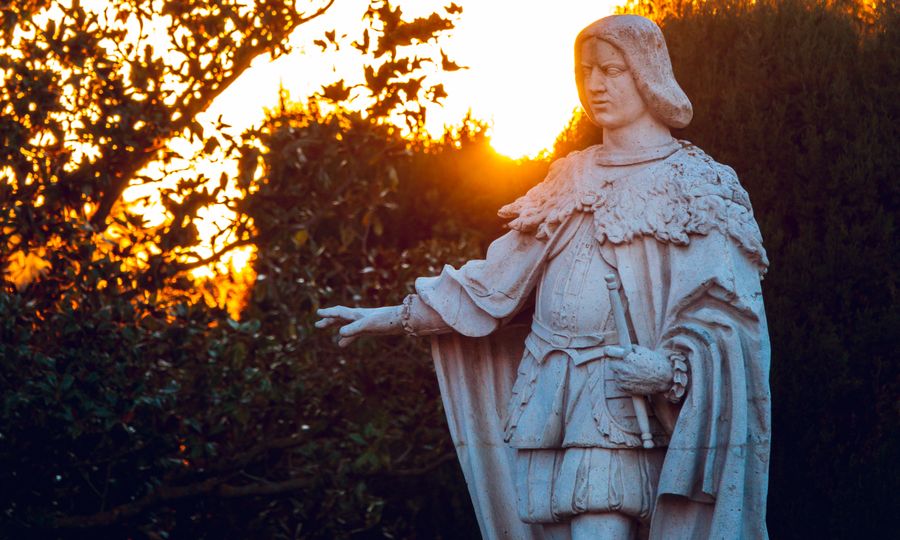

✡️ Was Christopher Columbus a Sephardic Jew? A Mystery That Still Fascinates Historians
More than five centuries after his death, Christopher Columbus remains one of the most debated figures in world history. Historians have long argued about his birthplace, nationality and even his true identity. Was he Genoese, as traditionally believed? Was he Portuguese? Galician? Or could he have been a Sephardic Jew from Spain?
Recent DNA research carried out in Spain has reignited this centuries-old debate, attracting international attention and opening new questions about the explorer who changed the course of world history.
For those interested in Jewish and Sephardic history, the discussion is particularly fascinating because it touches on one of the most dramatic moments in Spanish history: the year 1492, when Columbus sailed across the Atlantic and the Jews were expelled from Spain.
🧬 The DNA Study That Reopened the Debate
In 2024, Spanish researchers announced the results of a long-running investigation into the remains traditionally attributed to Christopher Columbus.
The study, led by forensic expert José Antonio Lorente, analysed genetic material associated with Columbus and members of his family, including his son Hernando Colón.
According to the researchers, the DNA evidence revealed genetic traits that were considered compatible with Jewish ancestry. The team suggested that Columbus may have belonged to a Sephardic Jewish family originating somewhere in Western Europe.
At the same time, the researchers acknowledged that determining his exact birthplace remains impossible with the available evidence.
The findings generated worldwide headlines, although many historians and geneticists have stressed that further academic analysis is needed before definitive conclusions can be drawn.
📜 Why Have Historians Suspected Jewish Origins for So Long?
The idea that Columbus may have had Jewish roots is not new. In fact, it has been discussed for more than a century.
Various researchers have pointed to several intriguing clues:
- His extensive use of Biblical language and references.
- His close connections with prominent converso families.
- The possibility that he deliberately concealed aspects of his background.
- The unusual secrecy surrounding his early life and origins.
- The coincidence between his voyages and the historical circumstances facing Spain’s Jewish population.
Some scholars have argued that Columbus may have belonged to a family of Jewish converts to Christianity, commonly known as conversos. Others have suggested that his family may have originated in Galicia or elsewhere in the Iberian Peninsula before adopting different identities.
None of these theories has ever been universally accepted, but they continue to generate considerable interest among historians.
🌍 The Galicia Theory and the Colón Family
One of the most famous alternative theories proposes that Columbus was not Italian at all, but rather a native of Galicia in northwestern Spain.
Researchers supporting this hypothesis identified references to a family named Colón living in Pontevedra during the fifteenth century. Some members of this family shared names remarkably similar to those associated with Columbus’s relatives.
Several authors also noted possible links between the Colón family and families believed to have Jewish origins.
Supporters of this theory argue that Columbus may have been born in Galicia and later adopted a different identity. Critics respond that extensive documentary evidence continues to support the traditional Genoese origin.
As with many aspects of Columbus’s life, the debate remains unresolved.
⚖️ What Most Historians Believe Today
The majority of historians still consider the traditional Genoese origin to be the most strongly documented explanation.
Numerous contemporary sources from the fifteenth and sixteenth centuries describe Columbus as being from Genoa or Liguria. Documents relating to the Colombo family of Genoa have long been regarded as important evidence supporting this interpretation.
At the same time, historians increasingly recognise that questions of identity in late medieval Spain were often complex. Families moved between regions, adopted new names and sometimes concealed their origins for religious or social reasons.
For this reason, the possibility of Sephardic ancestry continues to be explored, even if many details remain uncertain.
📅 Why 1492 Matters So Much
Whether Columbus was Sephardic or not, his story is inseparable from the events of 1492.
That year witnessed two developments that transformed world history:
- The departure of Columbus on his first Atlantic voyage.
- The expulsion of the Jews from Spain under the Alhambra Decree.
For Sephardic Jews, 1492 marked the end of centuries of Jewish life in medieval Spain. Thousands left for Portugal, North Africa, Italy, the Ottoman Empire and other regions, carrying with them the traditions of Sepharad.
At the very same moment, Spain was beginning its expansion into the Americas.
The coincidence of these two events has fascinated historians for generations and helps explain why Columbus occupies a unique place in discussions about Jewish and Sephardic history.
🏙️ What Does This Mean for Jewish History in Seville?
Seville was one of the most important cities in medieval Jewish Spain. Its Jewish quarter, today associated with the charming neighbourhood of Santa Cruz, was once home to a thriving Sephardic community.
Although much of that world disappeared after persecution, forced conversions and expulsion, its legacy remains deeply woven into the city’s history.
The debate surrounding Columbus’s possible Jewish ancestry offers another fascinating lens through which to understand the cultural, religious and political transformations that shaped Spain at the end of the Middle Ages.
For visitors interested in Sephardic history, the question is not simply whether Columbus was Jewish. It is also about understanding the world in which he lived—a world where identity, religion and family origins could be matters of survival.
🏛️ Should Columbus Be Mentioned During a Jewish Heritage Tour of Seville?
In our view, absolutely.
Not because we can definitively state that Christopher Columbus was a Sephardic Jew, but because his story opens an important conversation about Sepharad, the expulsion, the conversos and the profound transformations of 1492.
The recent DNA research has made the debate more relevant than ever, offering visitors a fascinating example of how history continues to evolve as new evidence emerges.
For those exploring Jewish heritage in Seville, Columbus represents one of the most intriguing unresolved mysteries connected to the final years of Jewish Spain.
✨ Discover the Jewish History of Seville
The story of Sepharad is far richer than a single monument or historical figure. It is a story of communities, traditions, scholarship, resilience and memory.
During our Jewish Seville tour, we explore the former Jewish Quarter, the legacy of Sephardic culture and the fascinating historical debates that continue to shape our understanding of Spain’s past.
From medieval synagogues and converso families to the mysteries surrounding Christopher Columbus, Seville offers a unique opportunity to discover one of the most remarkable chapters in Jewish history.
💡 Historical Note: The question of whether Christopher Columbus was a Sephardic Jew remains open to debate. Recent DNA studies have revived the discussion, but historians continue to examine the evidence and different interpretations.
🕍 Interested in Sephardic heritage in Seville?
Discover the former Jewish Quarter, Sephardic traditions and the hidden stories of Jewish Spain with an expert guide.






Leave a Comment